What This Page Is, Honestly
Let’s be straight about what you have found. This page is not an input box that spits out keyword ideas. It is the working method behind keyword research for both classic SEO and Answer Engine Optimization, written so you can run it with whatever data you have today. AEO Goal’s actual keyword research tool lives inside the app behind a free trial: it returns estimated monthly search volume, a 0 to 100 difficulty score, SERP features, intent classification, a question-format filter, and a metric most keyword tools do not have, how often a query triggers an AI generated answer. The details are in the keyword research feature guide.
If you want something free and instant right now, run the free AI visibility scan instead. It will not give you keywords, but it will tell you whether the pages you plan to rank are even eligible to be crawled and cited, which is the prerequisite this whole exercise depends on.
How Keyword Research Actually Works Underneath
Every keyword tool, ours included, is built on the same mechanics, and knowing them keeps you from misreading the numbers:
- Volume is an estimate, not a count. Search engines do not publish query logs. Volume figures are modeled from clickstream panels and ad platform data, then smoothed. Treat them as order-of-magnitude signals: the difference between 10 and 10,000 counts, the difference between 480 and 590 does not.
- Difficulty is a proxy for the current winners. Difficulty scores are computed from the authority of pages currently ranking. A 0 to 100 difficulty number tells you how strong the incumbents are, not whether your specific page can win. A highly relevant page from a moderate-authority site beats an off-topic page from a strong one regularly.
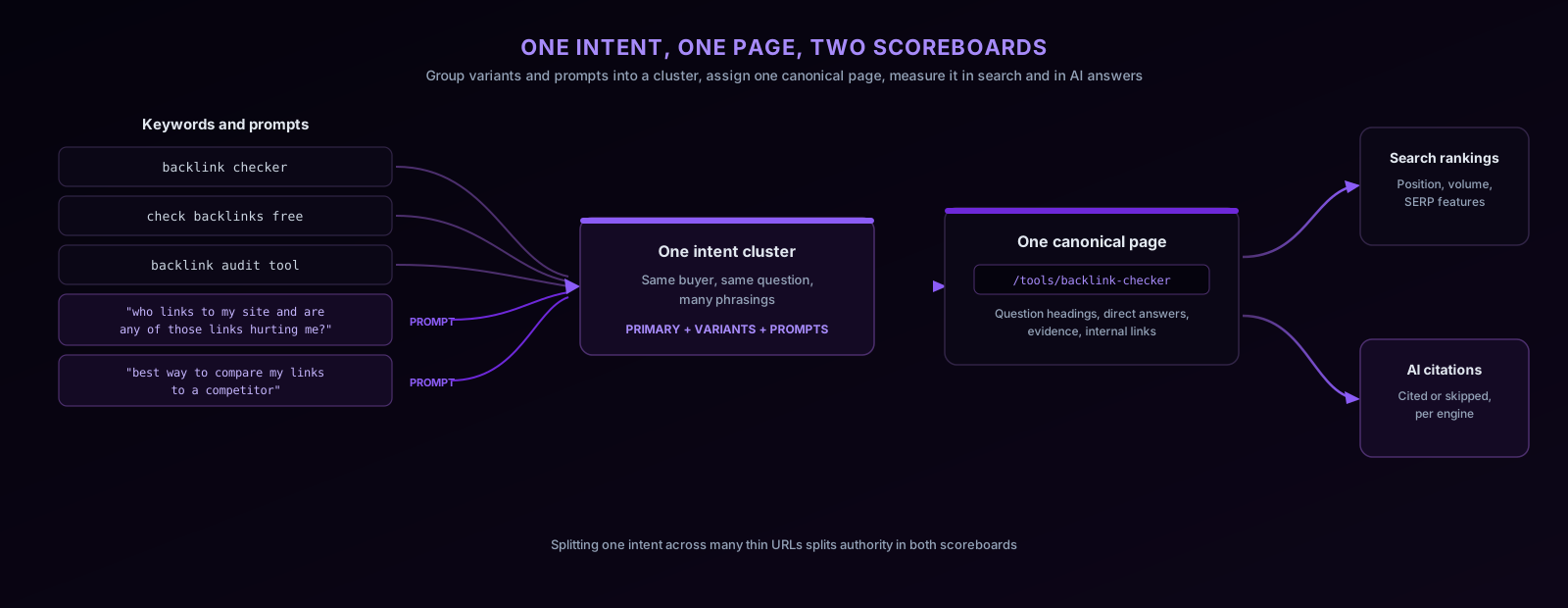
- Intent is the real unit of research. “backlink checker”, “check backlinks free”, and “how do I see who links to my site” are three strings and one intent. Engines cluster them; your page map should too.
- Prompts are keywords without a volume column. People now ask complete questions inside ChatGPT, Claude, Gemini, and Perplexity. No public dataset reports how often. You prioritize prompts by buyer relevance and by observed engine behavior, which is what AI citation tracking measures directly.
How To Interpret Each Metric The Tool Returns
| Metric | What it tells you | What it does not tell you |
|---|---|---|
| Search volume | Relative demand in the search box | Demand inside chat interfaces, which is invisible to volume data |
| Difficulty (0 to 100) | Strength of pages currently ranking | Whether your page, with your relevance, can displace them |
| SERP features | Whether the result page has snippets, People Also Ask, or other modules that absorb clicks | Whether you will win the feature |
| Intent classification | What the searcher is trying to do: learn, compare, buy | Nuance within a cluster; read the live results for that |
| AI answer frequency | How often the query produces an AI generated answer | Whether that answer cites you; citation tracking answers that |
| Question filter | Which queries are phrased as questions, the closest analog to prompts | The exact wording buyers use in chat, which you get from prompt research |
The decision logic across the columns: high volume plus high AI answer frequency means the query’s clicks are being absorbed by generated answers, so being the cited source counts as much as the blue-link rank. High volume with low AI answer frequency is a classic SEO play. Low volume question-format queries are your prompt candidates, cheap to win and often the exact phrasing engines see.
Decision Rules For Building The Page Map
- Cluster first, pick URLs second. Group every variant and prompt that a single page could satisfy. If two queries would deserve meaningfully different pages in the buyer’s eyes, they are different clusters.
- One canonical page per cluster. Assign each cluster exactly one target URL. Every future variant routes there via internal links, never via a new thin page.
- Improve before you create. If an existing page already has impressions for the cluster (check Google Search Console), refresh that page. A URL with history beats a fresh one for the same intent.
- Let prompts shape the outline. The question-format queries and prompts in the cluster become H2s with direct answers underneath, the structure that both featured snippets and answer engines extract. The content optimizer guide covers that structure in detail.
- Define success per cluster before writing. For search-heavy clusters, the target is a ranking, tracked with rank tracking. For prompt-heavy clusters, the target is a citation, tracked per engine with AI visibility tracking.
Common Mistakes
- A page per variant. The oldest self-inflicted wound in SEO. Ten thin pages for ten phrasings of one question split authority ten ways and give answer engines ten weak candidates instead of one strong one.
- Filtering out zero-volume queries. For AEO this deletes your best targets. Volume tools cannot see chat interfaces; a “zero volume” question may be asked in ChatGPT daily.
- Reading difficulty as a verdict. Difficulty describes incumbents. If your page would be the most direct, most evidenced answer in the set, a scary difficulty number is often beatable.
- Ignoring the SERP features column. Ranking third under a featured snippet and an AI answer is not the third-place outcome it used to be. Check what the result page actually looks like before projecting traffic.
- Researching once. Prompt phrasing, SERP features, and AI answer frequency all drift. A page map from a year ago describes a search landscape that no longer exists.
When Free Methods Are Enough, And When They Are Not
You can get genuinely far without paying anyone: Google Search Console shows the queries you already rank for, autocomplete and People Also Ask expose question phrasing, and the clustering discipline above costs nothing but judgment. If that is your budget, start there, and use the keyword research guide as the long-form companion.
What free methods cannot do is quantify or verify. They will not tell you volume or difficulty for queries you do not rank on yet, how often a query triggers an AI answer, or whether any engine cites you when it answers. That is the boundary where the product starts. Inside AEO Goal, keyword research sits next to the rest of the loop: the AEO agent finds the prompts and keywords where competitors are cited and you are absent, ships a concrete fix such as an answer-first brief for the assigned page, and re-checks on the next scan whether rankings and Share of Model moved. Research that ends in a spreadsheet is trivia; research that ends in a measured fix is a program. See pricing for where the trial starts, or compare alternatives in best AI SEO tools first.