What A Content Optimizer Is, Honestly
A content optimizer improves a page you already have instead of publishing another URL. That framing is important, because the reflex it replaces, spinning up a new thin page for every keyword variant, is the single most common way teams dilute their own authority: five fragments chasing one intent compete with each other, and none of them becomes the page an engine trusts enough to cite.
Let’s be equally plain about what is on this page. There is no paste-your-text-here widget below. This page is the method: the three levers that determine whether an answer engine can quote a page, the order to work them in, and the decision rules for reading the scores. The measurement tools are real but live elsewhere: the free AI visibility scan checks a domain’s homepage-level signals live with no signup, and inside the app the Quality Gate scores every crawled page 0 to 100 for AI citability and turns each gap into a concrete recommendation.
Why Section Structure Became The Job
Classic SEO optimization tuned a page to rank as a whole: title tag, headings, internal links, on-page relevance. All of that still applies. What changed with Answer Engine Optimization is the unit of selection. When ChatGPT, Perplexity, or Gemini assembles an answer, it does not award your URL a position; it retrieves candidate passages and quotes the ones that answer the question cleanly. Rankings are won by pages. Citations are won by passages.
That shifts optimization work down one level. A page can be well-linked, fast, and topically relevant and still never get cited, because every one of its sections buries the conclusion under three paragraphs of setup, leans on pronouns that only make sense in context, or hedges the answer into mush. The fix is rarely new research. It is restructuring what the page already knows.
The Three Levers
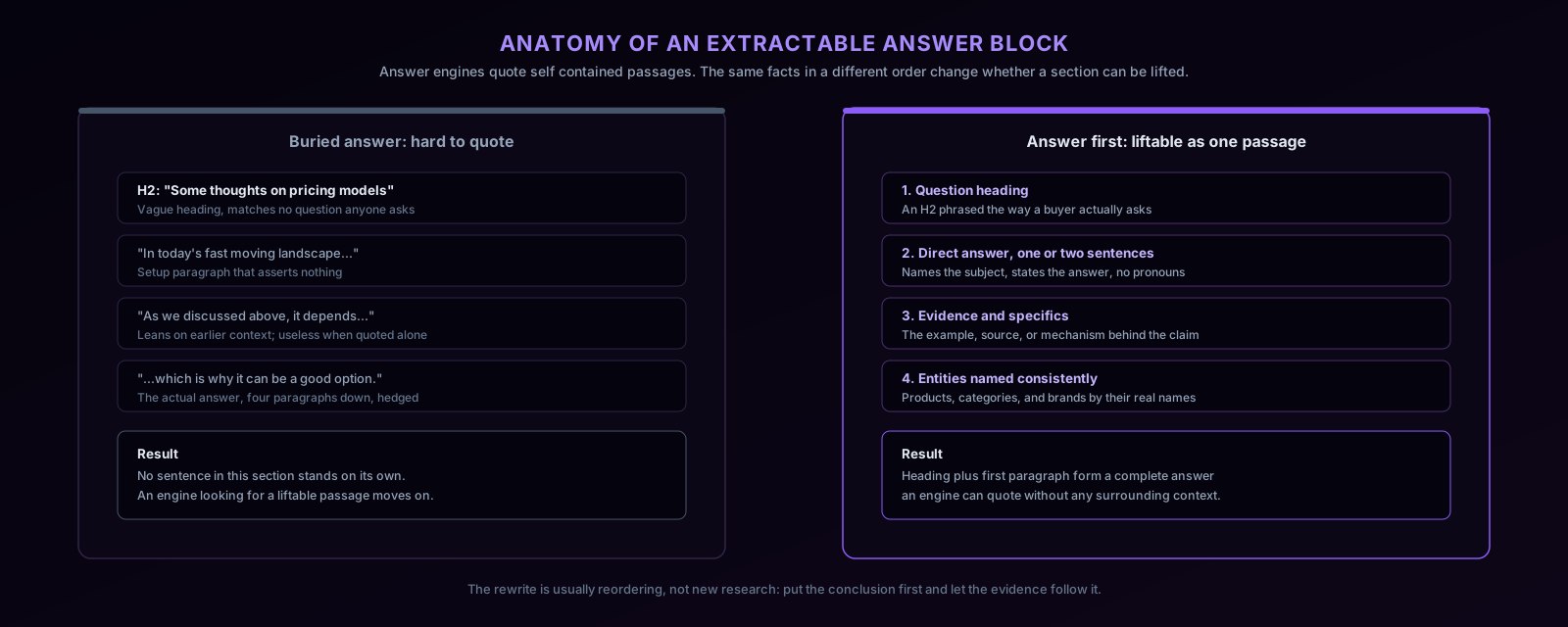
Lever 1: answer-first structure. Every section should open with its conclusion, stated in one or two sentences that could be quoted alone. Phrase the heading the way a person actually asks the question, then answer it immediately, then spend the rest of the section on evidence and nuance. Journalists call this the inverted pyramid; for AEO it is the single highest-leverage edit, because engines extracting passages strongly favor sections where heading plus first paragraph form a complete answer.
Lever 2: entity clarity. Engines resolve pages to entities: your product, your category, your competitors, the concepts you explain. Help them. Use the real, full name of your product and brand consistently instead of rotating through synonyms for variety. Define category terms once, plainly. State relationships explicitly: what the product is, what category it belongs to, who it is for, what it replaces. On the technical side, Organization schema with a sameAs cluster ties the words on the page to a resolvable entity, and the free scan measures entity salience, meaning how strongly your homepage actually signals who you are.
Lever 3: extractability. A passage is extractable when it survives being lifted out of the page. That means no sentences that begin “as we discussed above,” no answers that only exist inside a client-rendered widget or an image, no claims whose subject is a pronoun. It also means the machine-readable layer agrees with the visible one: structured data describing content that is not actually on the page is a credibility liability, not a boost. Server-render anything you want quoted.
How To Run An Optimization Pass
Work in this order; each step assumes the one before it.
- Clear the retrieval blockers first. Structure work is wasted on a page engines cannot fetch or parse. Confirm crawlability, indexability, canonical health, and AI crawler access before touching a sentence; the technical SEO audit guide covers this gate by gate, and the free scan checks it in one pass.
- Rewrite every section opening. Go heading by heading. Turn vague headings into the question the section answers. Move each section’s conclusion into its first one or two sentences. This is reordering, not rewriting; most of the words already exist further down.
- Do the entity pass. One canonical name per thing, used consistently. Define terms a buyer would ask about. Check that the page states plainly what the product is and who it is for, somewhere quotable.
- Back or cut every claim. For each assertion, either attach real evidence, an example, a source, a mechanism, or delete the assertion. Never manufacture a statistic to look authoritative: a fabricated number is exactly the kind of unverifiable claim that costs credibility with engines built to cross-check sources, and it can get quoted under your name.
- Add the questions readers ask next. Cover the natural follow-ups in the body or a FAQ section, and add FAQPage schema only where the questions are visibly answered on the page.
- Re-score and verify. Re-run whichever scorer you used, then check the only measure that is not a proxy: whether AI answers actually start citing the page, via AI citation tracking.
How To Read The Scores
The free scan grades homepage-level signals: H1 structure, title and meta health, JSON-LD presence and validity, llms.txt, AI crawler access, and entity salience, returned as a 0 to 100 score with ranked issues. It answers “is this domain structurally ready to be cited” for the page that defines your entity.
Inside the app, two scores do the page-level work. Drafts from the blog generator get an AEO Quality Score measuring question-answer structure density, entity coverage, citation potential, and E-E-A-T signals; the working rule is 70 or higher before publishing. For pages already live, the Quality Gate assigns an AI Citability Score per crawled page:
| Score | Read it as |
|---|---|
| 80 to 100 | High citability; a strong candidate, keep it fresh |
| 60 to 79 | Right bones, specific gaps; the classic optimization target |
| 40 to 59 | Answers buried and entities unclear; rework section openings and naming |
| 0 to 39 | Unlikely to be cited; treat as a rewrite, not a touch-up |
Each scored page comes with specific recommendations, add an author bio with credentials, add FAQ schema for the questions in your H2s, add original data, update the publication date, and any of them can be pushed to the ticket board so findings become owned work instead of a report.
Decision Rules
- Optimize when the page owns the right intent and scores in the middle band. This is the highest-ROI case: the research exists, the structure is the problem.
- Rewrite when the score is on the floor and the section openings, entities, and evidence are all missing. Reordering cannot save a page with nothing to reorder.
- Consolidate when several thin pages chase one intent. Merge them into the strongest URL, redirect the rest, and optimize the survivor. One authoritative page beats five fragments splitting the signal.
- Leave it alone when a page is scoring high and earning citations. Keep the dates and facts current and spend the effort on the next gap. Optimization has diminishing returns past the point where sections are already liftable.
Common Mistakes
- Carrying keyword-stuffing habits into AEO. Repeating the target phrase does not make a passage more quotable; answering the question does.
- Polishing prose on an unfetchable page. If GPTBot or PerplexityBot is blocked, or the page is noindexed, no amount of structure counts. Gate one first.
- Optimizing the whole page when only the openings are broken. Most middling pages need their conclusions moved up, not a rewrite. Diagnose before demolishing.
- Schema that oversells the page. FAQ markup for questions the page never visibly answers, or Organization claims the site does not support, reads as manipulation to systems built to verify.
- Declaring victory on a score. A score is a proxy. The loop closes only when citation tracking shows the page appearing in real answers, and Share of Model moving against the competitors you track.
Free Versus Product: The Honest Boundary
Free, right now, no signup: this method, and the AI visibility scan as a live check of the homepage-level signals that decide whether your domain is citable at all. That is genuinely enough to find and fix your biggest structural problems on the page that counts most.
What it cannot do is scale or verify. Scoring every page on the site is the Quality Gate over the site crawler’s output. Rewriting at volume with the structure built in is AEO content generation plus the block editor’s review gate. And proving the work moved anything is citation tracking across up to nine AI answer engines: ChatGPT, Claude, Gemini, Perplexity, Google AI Overviews, Microsoft Copilot, Grok, Meta AI, and DeepSeek. That loop, find the gap, ship the concrete fix, re-check that it worked, is the AEO Goal agent’s whole job; this page just teaches you to run one turn of it by hand.