What A Technical SEO Audit Is
A technical SEO audit answers one question: can the right page be discovered, fetched, indexed, understood, and reused, by search engines and by AI answer engines. Everything else in an SEO or Answer Engine Optimization program sits on top of that yes. Content quality, backlinks, and brilliant positioning are all worth nothing to a page the crawlers never successfully read.
Here is what you can actually do from this page, stated plainly. The free AI visibility scan is a real, live technical audit scoped to one page: enter a domain with no signup, and it fetches your homepage, robots.txt, and llms.txt, discovers your sitemap, checks robots.txt access for 16 AI crawler user agents, and verifies indexability, canonical tags, JSON-LD structured data, H1 structure, title and meta description health, and Open Graph tags. It returns a 0 to 100 score and a ranked issue list. The site-wide version, which crawls every internal page and re-runs on a schedule, is the audit feature inside the app.
The Four Gates A Page Must Pass
Technical SEO stops being a 200-item checklist once you see it as four sequential gates. A page that fails gate one never gets judged at gate four.
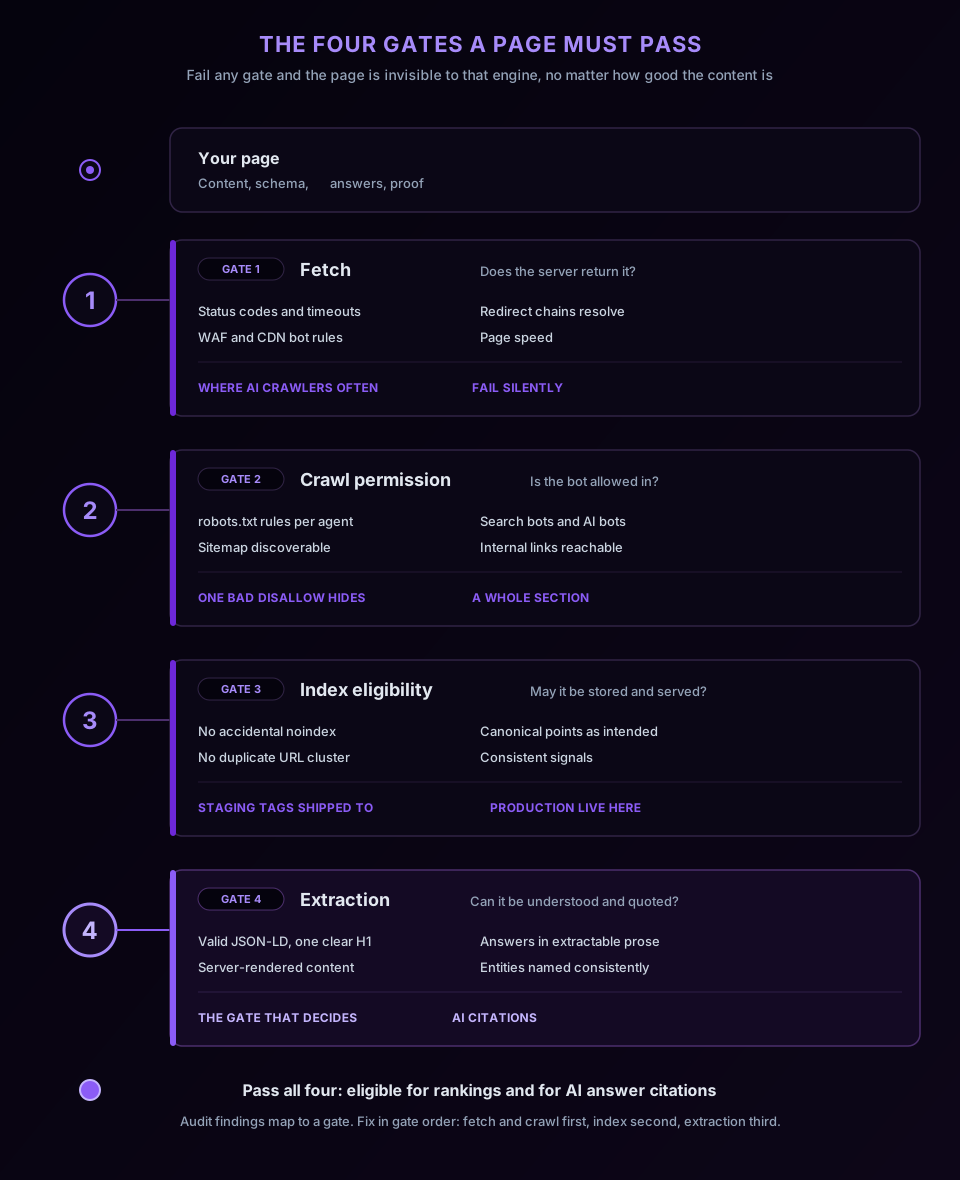
Gate 1: Fetch. The server must return the page. Timeouts, 5xx errors, WAF and CDN rules that challenge bots, and redirect chains that never resolve all fail this gate. AI crawlers are failed here disproportionately often, because bot protection presets frequently block their user agents by default while leaving Googlebot alone.
Gate 2: Crawl permission. robots.txt decides who may fetch what. One careless Disallow: / on a template, or a blanket rule copied from staging, removes entire sections from every crawler’s reach. The robots.txt guide covers the rules and the AI crawler user agents in detail.
Gate 3: Index eligibility. A fetched page still needs permission to be stored and served: no stray noindex directives, a canonical tag pointing where you intend, and no duplicate cluster confusing which URL is the real one. The classic self-inflicted wound lives here: a noindex meta tag shipped from staging to production.
Gate 4: Extraction. The page must be understandable. Valid JSON-LD that matches the visible content, one clear H1, headings that scope sections, and answers stated in extractable prose rather than buried in client-rendered widgets. This gate barely mattered a decade ago; for answer engines it is decisive, because they quote passages, not pages.
How To Read Audit Findings
| Finding | Gate | How urgent |
|---|---|---|
| Server errors, unresolvable redirects | Fetch | Immediate: the page does not exist to crawlers |
| AI crawlers blocked in robots.txt | Crawl | Immediate if you want AI answer visibility; deliberate policy if you do not |
| Accidental noindex, conflicting canonicals | Index | Immediate: eligible content is being discarded |
| Redirect chains | Fetch and Index | High: each hop wastes crawl budget and dilutes signals |
| Broken internal links | Crawl | High: they leak discovery paths and user trust |
| Duplicate or missing titles and metas | Extraction | Medium: fix in batches by template |
| Malformed or missing JSON-LD | Extraction | Medium-high for AEO: schema is how engines resolve entities |
| Slow pages (LCP) | Fetch and user experience | Medium: fix worst offenders first |
| No question and answer structure | Extraction | The AEO-specific finding: the page is readable but not quotable |
Two interpretation rules. First, severity is positional: a medium issue on your highest-converting template outranks a critical issue on a forgotten tag page. Weight findings by the traffic and revenue of the affected pages. Second, count issues by root cause, not by instance: five thousand duplicate title warnings are usually one template bug, which means one ticket, not five thousand.
Decision Rules For Working The Backlog
- Never audit without fixing. An audit that ends in a PDF is a stalling tactic. Every finding should become an owned ticket; the in-app audit pushes findings straight to a ticket board for exactly this reason.
- Work the gates in order. Fetch and crawl fixes first, index fixes second, extraction fixes third. Optimizing schema on a page AI crawlers cannot fetch is polishing furniture in a locked house.
- Fix templates, not pages. Most technical debt is generated by templates. One template fix repairs thousands of URLs at once.
- Re-run after every fix batch. The free scan is repeatable on demand, and the in-app audit runs weekly or monthly. A finding is not fixed until a re-run stops reporting it.
- Watch for regressions, not just fixes. The audit’s most valuable catch is the new issue that appeared after Tuesday’s deploy, while it affects days of traffic instead of months.
Common Mistakes
- Auditing once a year. Technical health decays with every release. Yearly audits document the damage; scheduled audits prevent it.
- Trusting the SEO checks while ignoring AI access. A site can be flawless for Googlebot and invisible to GPTBot, PerplexityBot, and ClaudeBot because a firewall preset blocked them. Classic audit tools rarely check this; the free scan checks it first.
- Blocking a page you want deindexed. To remove an indexed page, crawlers must be able to fetch the noindex directive. Blocking the URL in robots.txt preserves the stale listing instead of removing it.
- Schema that contradicts the page. Structured data describing content that is not visibly there is a credibility liability. Validate against what users see; see the structured data glossary entry.
- Assuming JavaScript content gets read. Some crawlers render JavaScript, many AI crawlers effectively do not. Content that only exists after client-side rendering is invisible to them. Server-render anything you want quoted.
Free Scan Versus Full Audit: The Honest Boundary
The free scan is enough to answer “is this domain fundamentally open for business with search and AI engines?” It reads one page plus the access files, and because those files are sitewide, a robots.txt or llms.txt finding applies to your whole domain. Run it before and after every significant release; it costs nothing.
It is not enough for site-wide assurance. It cannot find the broken links on page 40, the redirect chain in your blog archive, or the template that lost its FAQ schema last month. That is the in-app audit: the site crawler follows internal links across the site (respecting robots.txt and noindex, with configurable depth and JavaScript rendering), most sites under a thousand pages finish in minutes, and every page gets checked and scored for citability by the quality gate. Findings land in one prioritized queue next to your AI citation tracking gaps, which is the point of the AEO Goal agent: find the gap, ship the concrete fix, re-check that it worked. For a manual checklist to work through in the meantime, the technical SEO checklist is free.