How to choose the best AI SEO tools
The best AI SEO tools help you answer a question traditional SEO software cannot: when a buyer asks ChatGPT, Claude, Gemini, or Perplexity about your category, does the answer mention you, cite your pages, or recommend a competitor instead? A strong AI SEO stack combines AI visibility tracking, AI citation tracking, competitor visibility, technical crawlability checks, structured data, and answer-first content workflows.
This page is a decision framework, not a promotional ranking. It does not make claims about competitors’ current pricing, packaging, or features - those change often and must be verified with each vendor. What it does give you is a clear way to evaluate any tool in this category, and an honest account of where AEO Goal is the right choice.
The one question that separates the best AI SEO tools
Most tools marketed as “AI SEO” fall into one of two traps. Either they bolt an AI label onto traditional rank tracking and never actually read AI answers, or they measure AI answers but stop at a citation-rate chart and leave you to figure out what to do. The best AI SEO tools clear a higher bar on two axes:
- Do they measure AI answers directly? Not rankings as a proxy, but the actual generated answers - mentions, cited source URLs, position, sentiment, and share of model, across multiple engines.
- Do they act on what they find? A tracker tells you your citation rate. The best tools tell you which prompt you lost, which competitor page won, why, and what to change - then confirm on the next run whether it worked.
That second axis is the one buyers underweight and regret. A number you cannot act on is a cost, not an asset. AEO Goal is built to lead on both: it is an AEO agent, not a dashboard, so every gap it surfaces ships with a fix path and a re-check.
A simple test to run during a trial: ask the tool which prompt you are losing, to which competitor, and what specifically to change. A tracker shows you a chart. An agent names the prompt, surfaces the competitor page the engine cited, explains why yours was skipped, and hands you the brief to close the gap. If a tool cannot answer that question in a demo, it will not answer it after you buy.
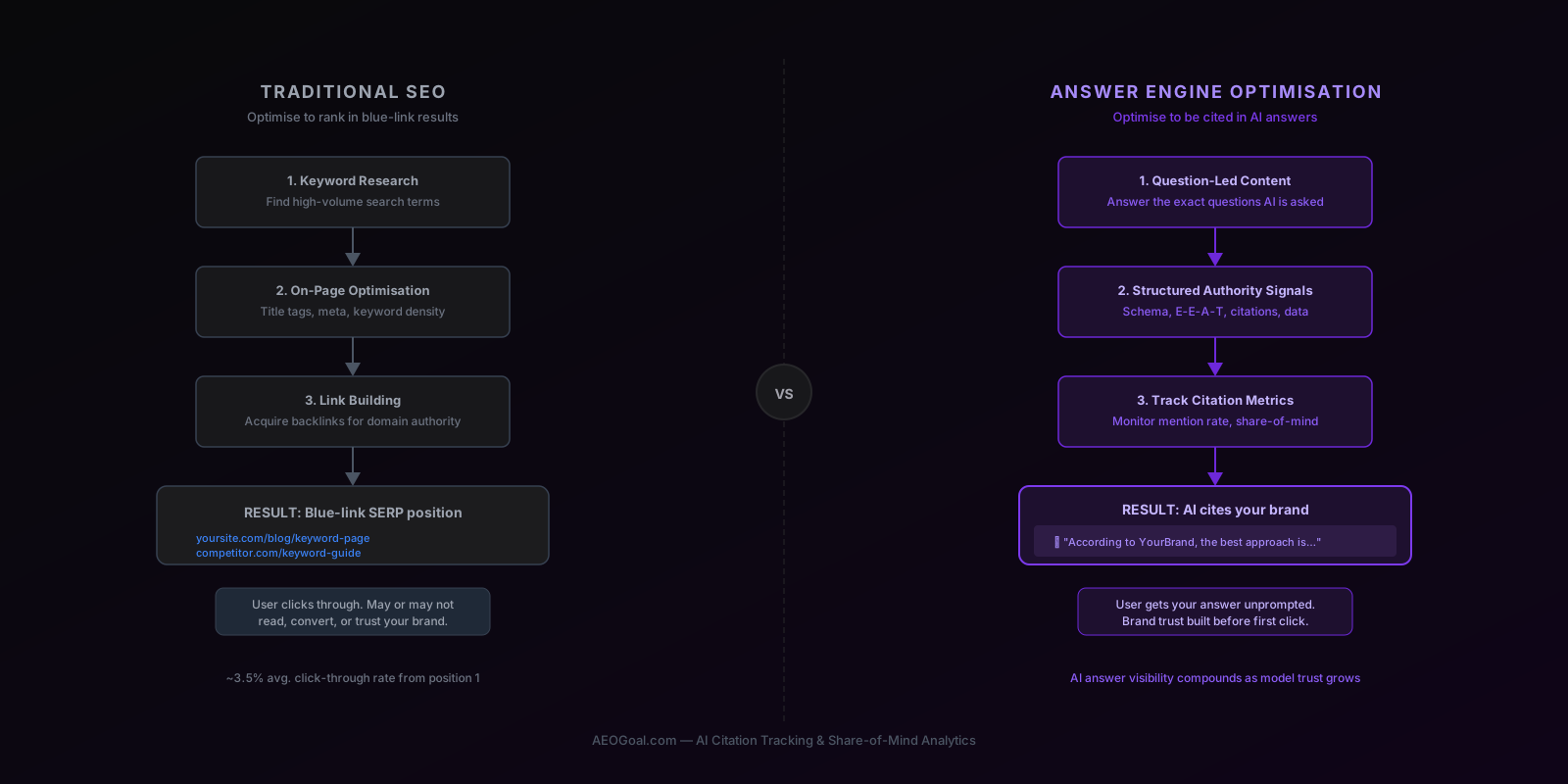
What the best AI SEO tools must do
When shortlisting, check each tool against the capabilities that decide whether you gain visibility in AI answers. Confirm each one in a trial, not just on a features page:
| Capability | Why it is important |
|---|---|
| AI visibility tracking | Shows whether answer engines mention the brand for priority prompts, as a trend - not a one-off check. |
| Citation tracking | Shows which source URLs AI answers draw from - mentioned and cited are different signals; conflating them inflates your numbers. |
| Competitor visibility | Shows which competitors win answer presence and which of their pages are cited - the clearest opportunity map in the category. |
| Technical SEO checks | Confirms crawlability, canonicals, robots, sitemap, metadata, and schema readiness for AI crawlers. |
| Content briefs | Turns answer gaps into specific page updates or new pages a writer can execute - not generic copy. |
| Fix-and-recheck loop | Maps each gap to a concrete action and re-measures whether it moved - the difference between a tracker and an agent. |
| Reporting | Shows trend, share of model, and executive context without raw exports. |
| Governance | Covers access control, rate limits, data handling, retention, and procurement requirements. |
The first three tell you where you stand; the middle three decide whether you can do anything about it; the last two decide whether the tool survives an enterprise review.
Three categories buyers confuse
When teams search for AI SEO software, they are usually evaluating three different product types without realizing it:
- Traditional SEO platforms adding AI features. Strong at rank tracking, backlinks, and crawl audits, with AI bolted on. Best when your primary need is still classic search datasets at scale.
- AI writing tools adding SEO suggestions. Strong at drafting copy, weak at measuring whether that copy is actually retrieved or cited. Best as a drafting aid, not a visibility system.
- Answer-engine optimization platforms. Purpose-built to measure AI visibility directly and turn it into action. Best when the buying question is “are we present and cited in AI answers, and how do we fix it?”
The right shortlist depends on whether the team’s primary need is rank tracking, technical audits, content generation, citation monitoring, competitor answer visibility, or executive reporting. Most mature teams run an AEO platform alongside a traditional suite.
What sets AEO Goal apart
Most AI SEO tools land in one of two modes: they track AI answers and produce a dashboard, or they generate AI-assisted content with light SEO suggestions. AEO Goal is built on a third premise: measurement is only valuable if it changes what you publish and fix next, and that change should be automatic, not manual.
Here is what that means in practice:
- Nine AI engines covered. AEO Goal tracks your brand across ChatGPT, Claude, Gemini, Perplexity, Google AI Overviews, Microsoft Copilot, Grok, Meta AI, and DeepSeek - not the two or three most tools default to. The engines your buyers actually use are not all the same engine, and coverage gaps blind you to where you are losing.
- Citation vs mention, separated. A brand can be named without its pages being cited, and cited without being named. AEO Goal tracks both signals and reports them separately - most tools conflate them, giving you a number that looks better than your actual content authority.
- Competitor page-level visibility. You see not just that a competitor outranks you in AI answers, but which specific pages the engine cited for them. That is the gap you close, not a leaderboard.
- Agent layer, not just a dashboard. When AEO Goal surfaces a citation gap, it explains the cause - weak answer structure, missing schema, a blocked AI crawler, thin evidence, no citable source page - and ships the concrete fix: an answer-first brief, a schema recommendation, an llms.txt or robots.txt change, or a page to publish. Then it re-checks on the next run whether the fix moved citations, mentions, or share of model.
- Traditional SEO included. AEO Goal also carries keyword research, daily rank tracking, and backlink analysis with a DR-weighted Domain Score and its own AI-citation AEO Rank. Teams run one prioritized backlog instead of paying for and reconciling two tools.
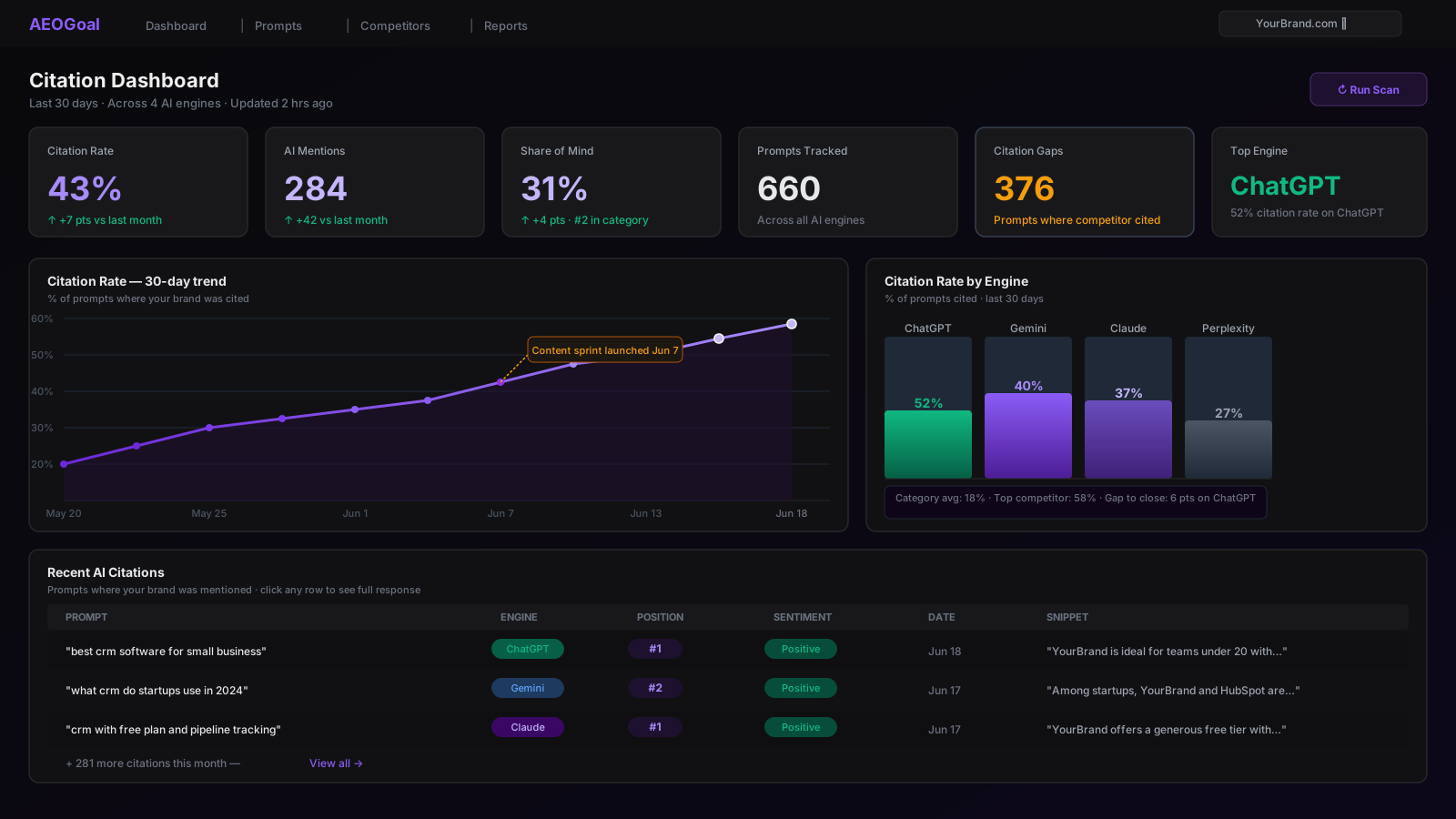
How AEO Goal compares on the capabilities that matter
| Capability | Typical tracker | Typical AI writing tool | AEO Goal |
|---|---|---|---|
| AI engines covered | 2-4 | None | 9 |
| Mentions vs citations | Conflated | Not measured | Separated |
| Competitor cited pages | Not shown | Not measured | Shown per prompt |
| Root-cause diagnosis | Not included | Not applicable | Included |
| Content brief from gap | Manual export | AI drafts from keywords | Generated from measured gap |
| Re-check after fix | Manual re-run | Not applicable | Automatic on next scan |
| Keyword rank tracking | Sometimes | Sometimes | Included |
| Backlink analysis | Sometimes | Not typically | Included with Domain Score |
| AEO Rank | Not available | Not available | Proprietary metric |
This is not a claim that AEO Goal is right for every buyer. Traditional SEO suites with years of backlink data and deep crawl infrastructure have breadth that no AEO-first platform matches at launch. If you need the largest raw keyword and backlink database in the category, pair AEO Goal with a specialist suite. If the primary question is “are we present and cited in AI answers, and what do we do about it,” AEO Goal is built to be the right answer.
AEO tools vs SEO tools
AEO tools and SEO tools answer different questions, which is why most teams run both. SEO tools measure where you rank and why; AEO tools measure whether AI answers mention and cite you, which sources they use, and how you compare to competitors inside generated answers. For the full breakdown of the difference between AEO tools and SEO tools, see our AEO vs traditional SEO comparison. To understand what AEO tools actually measure - citation count, share of voice, sentiment, and engine breakdown - see the AI citation tracking methodology.
An enterprise buying checklist
For an enterprise buying motion, a features page is not enough. Before you commit, verify in a trial and in the vendor’s documentation:
- Coverage and data. Which AI engines are covered, how prompts are sampled, and how often results refresh.
- Depth. Whether citation tracking distinguishes mentions from cited source URLs, and whether competitor share of answer is measured.
- Actionability. Whether the tool can explain how a finding becomes a specific task, and whether it re-checks the result.
- Governance. Access controls, SSO, rate limits, data retention, subprocessors, audit logs, and billing controls.
- Support and terms. Service-level commitments, API limits, and cancellation terms.
The tools worth buying can answer every one of these plainly. Be skeptical of any that answer the actionability question with a screenshot of a chart.
When AEO Goal is the right choice
- You need to know whether AI systems mention or omit your brand, as a trend across nine engines, not just two.
- You need citation source visibility - which page was used as evidence - not just keyword rankings.
- You need competitor overlap and share-of-mind reporting with the specific pages driving it.
- You want answer gaps turned into content briefs and remediation tasks, then re-checked.
- You want keyword research, rank tracking, and backlink analysis in the same tool as your AI citation data, on one prioritized backlog.
- You want a conservative, honest workflow that avoids unsupported reviews, ratings, and fabricated claims.
An honest note on comparisons
For AI SEO tools, do not rely on outdated review snippets, affiliate summaries, or scraped pricing - including any you find in an AI answer. Enterprise teams should verify current feature packaging, data retention, subprocessors, SSO options, auditability, API limits, and cancellation terms directly with each vendor before making a purchasing decision. New to the category? Start with what is AEO, or run a free AI visibility scan to see where you stand before you shortlist anything.